Recently I spent two weeks with a group of volunteers down at the Highlander Center in Tennessee. Highlander was at the heart of the labor movement in the thirties and forties, and the Civil Rights movement after that. Now Highlander is involved in many current struggles in the South.
A group of former Highlander supporters and staff members, plus some great volunteer carpenters, spent two weeks helping fix up the Horton House, the home of the late Myles Horton, Highlander’s founder and leader for many years. The renovation was under the care of the Johnny Bailey and Charlie Biggs of the Highlander staff, and Beth Eason, the school’s architect.
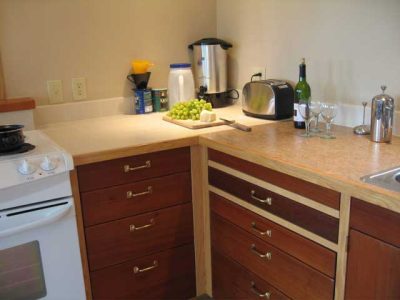
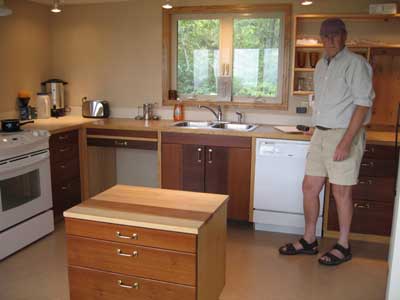
Working with Beth, Highlander was using ecological design principles throughout the renovation wherever possible. The house was also to be fully accessibility. The kitchen pictured here has several features that may be of interest to visitors to this website.
Photos by Charis Horton
The sink counter is linoleum, bonded to a plywood core. Linoleum is a natural material (jute, stone dust, linseed oil, wood fiber, etc), particularly in comparisan to laminates. We were very happy with the result. It looks great and so far seemed very easy to work with.
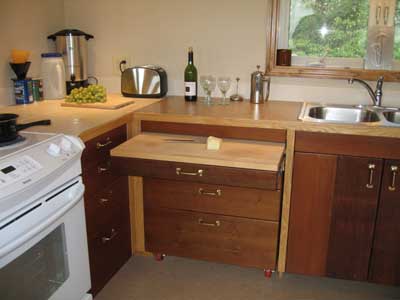
The cabinet to the left of the sink has a pull-out cutting board, that provides a lower wheelchair accessible work surface with kneespace below.
The drawer base below is on wheels and can be pulled out to make another kneespace. In that case the drawers on wheels become a movable island. The cabinet doors at the sink are on lift-off hinges, so that a kneespace can be provided easily there if needed.