Sam Clark Design

Our Cabinets

Our Cabinets

Materials and Construction

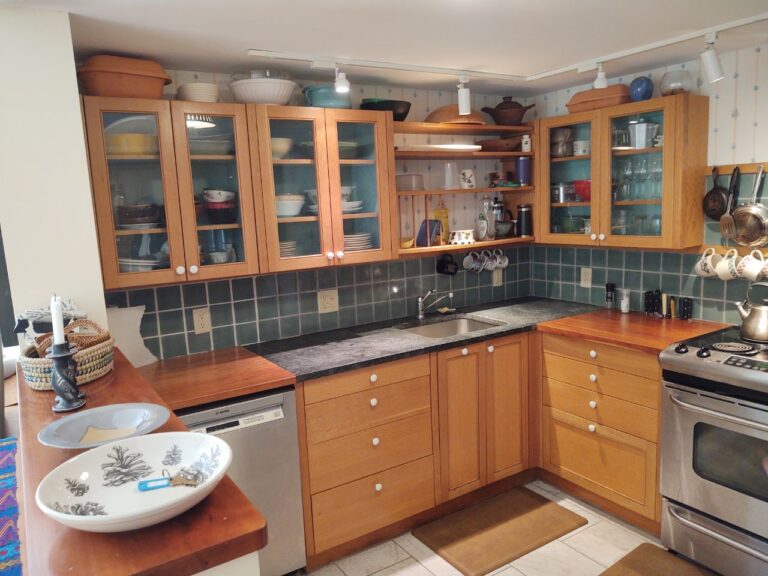
Typically we build wood cabinets with ¾” birch plywood cabinet boxes and dovetailed drawers, on heavy duty, full extension hardware. We primarily use Purebond™ plywood, which uses a soy-based adhesive rather than the more common urea-formaldehyde adhesives. The fronts – the parts that show – can be in any wood.  Recently we’ve used a lot of ash, which has some of the same stripey, contrasty elegance as pine, but is much tougher. We use a lot of cherry, too, and any wood is possible. 

We have our own cabinet system, called post style. It has the efficiency of European frameless cabinetry, but still looks like it was the product of woodworking craft, which it is. We often make either a simple flat panel door, or a “breadboard” door. We can also make a plywood door, painted or in a wood to match the cabinetry.

The basic idea is to build cabinets which feature the beauty of the wood itself. We go to great lengths to find wood with a beautiful grain, and show it to best advantage with grain matching and a good, clear finish. (Although we paint cabinets sometimes, too.)
Grain Matching

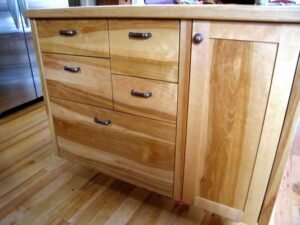
Grain matching is a traditional way to make the most of the grain patterns in wood as you put together any kind of panel. In this example, we’ve got five drawers in one cabinet. The usual approach would be to find a board that was about the right size for each drawer front, and cut it to size and install it. Wood is beautiful, so that would look fine.

In grain matching, we create one large panel for the whole cabinet front. After planing the boards, we line them up one way, then another to find the most beautiful combined grain pattern. We can also position pieces to minimize the potential for warping. We then glue the boards together into one large panel. Then we saw the panel down to the required sizes.

We often pick out boards with strongly contrasting colors. In the example, the same strong, dark streak of heartwood goes right through three different drawer fronts.

Sometimes the boards give us wonderful patterns, landscapes of wood grain.


Green Materials

Plywood: We use no particle board. Our cabinet boxes are made from 3/4” birch Purebond™ plywood, which is made with a soy based adhesive rather than the usual urea-formaldehyde glues.

Lumber: We are very interested in where the lumber that goes into our cabinets comes from. We want to use good quality wood that has been harvested in sustainable ways.

This is a complicated issue, with lots of trade-offs.  Let’s talk.

Counters: We prefer natural materials for our counters. Most of our kitchens have some amount of wood counter, either slabs made in our shop, or commercially available butcher block with an oil finish. We like stone counters, particularly around a sink or next to a stove, and are partial to slate from Vermont quarries, though native stone has now become prohibitively expensive.

Finishes:  For our cabinet interiors, we use a Vermont water based poly called Polywhey, made from byproducts from the cheese industry (whey).   For cabinet fronts, we use tung-oil-based finishes from Sutherland Welles. These are beautiful, low VOC (volatile organic compounds) oil finishes made in a variety of formulations. This company has put a lot of thought into developing finishes that are tough and have low VOC levels. 

Recycled Material: One of the best ways to have a more green kitchen is to reuse elements from your existing kitchen, or from other sources. We’ve often used nice old sinks or other appliances. An old counter can sometimes find a new home. An old table can become an island. An old “hoosier” cabinet from the ’20s can replace a segment of new cabinetry.

Drawers suited to contents: Our cabinets feature lots of drawers, often big drawers. A cabinet of carefully sized drawers can hold a lot more than a similarly wide door cabinet. We’ll work with you to figure out what goes where, and size the drawers to match, to provide maximum storage. With good full extension hardware, everything inside will also be easy to retrieve.

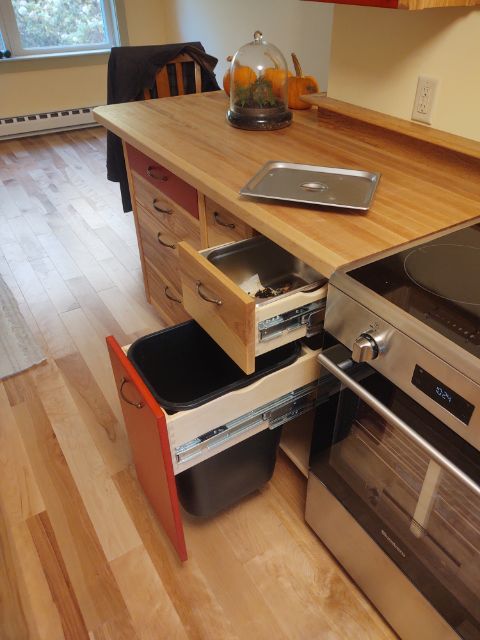
Some favorite details: There are certain details we use over and over because they are simple and work great. For example, we make a narrow cabinet with a pullout stainless steel compost bin, above, and one or two generous trash cans below. This works so well, it’s a feature of almost all our kitchens. We use a lot of open shelves, little racks, rows of hooks.

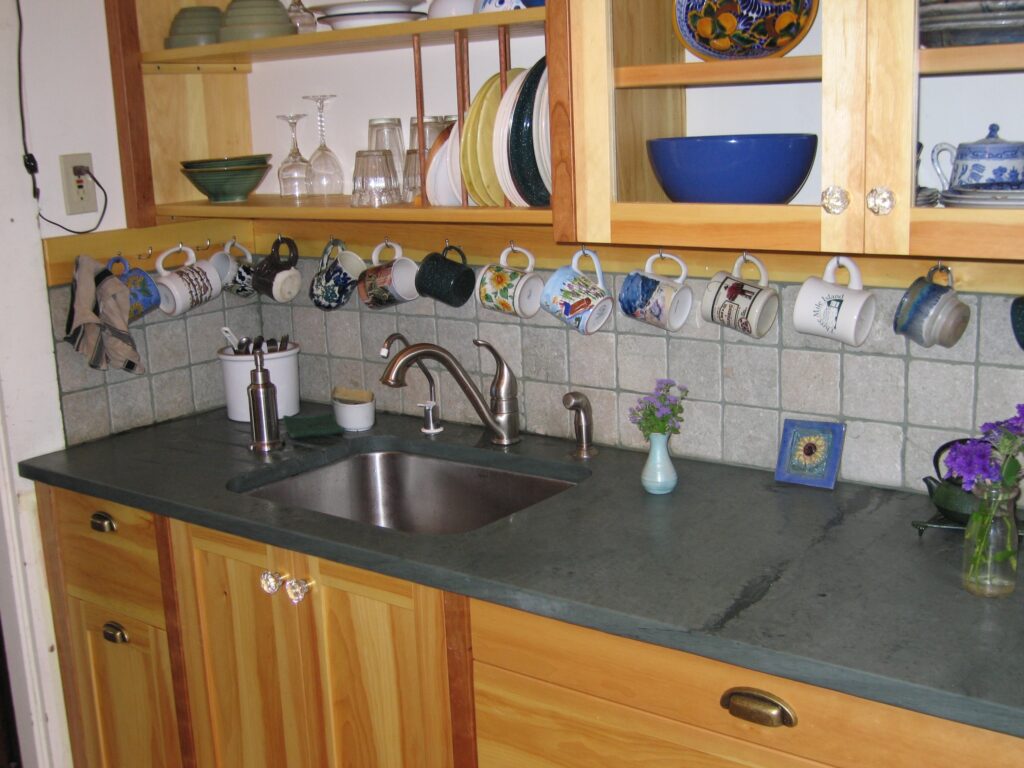
Dish Drainers: We’ve noticed that “wall mounted” dish drainers have recently become popular. These usually go right above or near the sink, which works great with stone sink counters.

We’ve been making these “wonder no-dry” dish drainers for many years. The idea is, you wash and rinse the dishes, then put them away wet. The excess water drips back into the sink. It saves space, and makes hand washing easy. Though many customers also have a dishwasher, it really is about as fast to hand wash as use a machine. In a very small kitchen, with minimal storage, eliminating the dishwasher can be one way to find crucial storage space. No electricity required.

“Wonder No-Dry: drainer and storage in one operation.”